May 19, 2021
Industrie Aérospatiale
Rolls-Royce (13 mai)
Rolls-Royce has said that “large (commercial) engine” flying hours in January-April were 40% of their 2019 level. It attributes this to cargo flights and continuation of key international routes and says that it is “broadly unchanged from the end of 2020”. The company also said that its planned sale of ITP Aero is “progressing well... with an encouraging range of interested parties”.
Airbus (12 mai)
Airbus relance le projet de ligne d'assemblage final (FAL) A320/A321 modernisée et numérisée qui remplacera l'une des FAL A320 originales de Toulouse et sera installée dans l'ancien site A380. Il devrait être opérationnelle d'ici fin 2022. Hambourg et Mobile sont actuellement les seuls sites de production d'Airbus configurés pour assembler des A321. Le A321neo représente maintenant plus de la moitié du carnet de commande de la famille A320 (5,650 avions).
CAE (12 mai)
CAE has been selected by Jaunt Air Mobility to lead the design and development of the Jaunt Aircraft Systems Integration Lab (JASIL) for its all-electric vertical take-off and landing (eVTOL) aircraft. Certification planning is set to begin in 2023 with entry-in-service (EIS) expected in early 2027. The JASIL is designed to de-risk the aircraft program's schedule and manage development costs by identifying integration issues and proving failure modes early in the program.
Airbus A320 family rate increases (11 mai)
Airbus suppliers are saying that they are being asked to prepare for a possible further 18% increase in A320-family jet output by the end of 2022 to 53 per month. So far Airbus has only committed to raising the rate in two steps to 45 a month by the end of 2021, from 40 now.
Boeing orders and deliveries (11 mai)
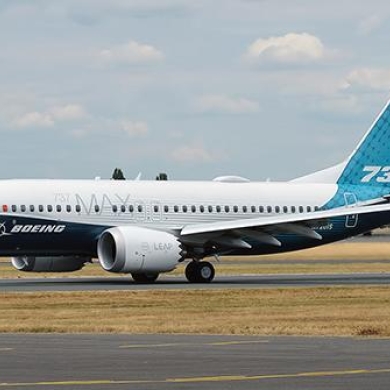
During April, Boeing logged orders for 25 airliners and cancellations for 17. The orders included five 777 Freighters, and 20 737 MAX. The 17 cancellations were all for 737 MAX including three from Air Lease whose offsetting orders and cancellations were “re-contracts for earlier delivery positions”. Deliveries totalled 17 aircraft including nine 787s. Boeing aims to deliver the majority of roughly 100 completed but not delivered 787s by year-end. April deliveries also included one 767F, one KC-46, two 777Fs and four 737 MAX.
Aircraft Electronics Association (11 mai)
AEA has stated that worldwide business and general aviation avionics sales in the first quarter fell 13.9 percent year-over-year, to $568.8 million. While almost $100 million less than a year ago, AEA said this represented a marginal increase from the fourth quarter sales. North America market accounted for 76 percent of sales.
Moody's (11 mai)
Moody's has upgraded its outlook for the global airlines industry to "positive" from "negative",
as the ratings agency expects steady vaccine rollouts across geographies to drive a rebound in
commercial air travel. It expects the industry to sustain operating losses and negative operating
margins in 2021, although to a lesser degree than in 2020.
Safran Landing Systems (10 mai)
Safran Landing Systems (SLS) a signé avec Bell Textron un accord portant sur les trains
d'atterrissage du Valor V-280, un aéronef à rotors basculants de nouvelle génération proposé à
l'armée américaine pour son programme d'hélicoptères de combat d'assaut de longue portée de
demain (FLRAA). SLS développera et fabriquera un système d'atterrissage entièrement intégré.
Les activités seront réalisées sur quatre sites de SLS en Amérique du Nord et en Europe. Le
pilotage sera effectué depuis Ajax, ON, l'un de ses sites canadiens.
GKN Aerospace (10 mai)
GKN Aerospace has produced an intermediate compressor case (ICC) for Rolls-Royce that
includes additive manufacturing. It was mainly manufactured using traditional casting
techniques, but several of the attaching parts were fabricated using additive manufacturing. The
production process also included a novel welding method. The ICC will be used in a
demonstrator program for the UltraFan engine. It was developed as part of Clean Sky 2 which is
part of the EU's Horizon 2020 program.
Qarbon Aerospace (10 mai)
Triumph Group has completed the divestment of three aerostructures composites
manufacturing facilities in Red Oak, TX, Milledgeville, GA and Rayong, Thailand to Arlington
Capital Partners which has renamed the businesses Qarbon Aerospace. The site in Red Oak
produces large, complex composite and metallic structures. These operations employ 900 staff.
MHI (10 mai)
Mitsubishi Heavy Industries' aircraft, defence and space unit narrowed its full-year losses, but
the SpaceJet programme will remain frozen in the near term. The unit reported an operating
loss of Y94.8 billion for the year ended 31 March. The SpaceJet programme cut its full-year
losses to Y116 billion, down from the previous year's Y263 billion. MHI will “continue type
certification documentation activities and assess [a] possible programme restart” of the
Spacejet during the fiscal year ending 31 March 2022.
Airbus Canada (8 mai)
Philippe Balducchi quitte ses fonctions de PDG d'Airbus Canada. Il a dirigé la transition du C
Series de Bombardier à l'A220 d'Airbus. Il était avec l'entreprise depuis 2001 et avait veillé entre
autres au démarrage de la FAL A220 de Mobile. C'est M. Benoît Schultz qui prendra la relève le
1er septembre 2021. Il avait été nommé Vice-président principal Approvisionnement, systèmes,
équipements et services en 2016. Puis en 2018, sa responsabilité a été étendue pour inclure
l'approvisionnement stratégique et commercial des systèmes de l'A220.
Enjet Aero (3 mai)
Kansas City-based aerospace company, Enjet Aero, announced today the acquisition of Birken
Manufacturing. Birken Manufacturing, based in Hartford, Connecticut, is a high performing
supplier of complex aeroengine components to Pratt & Whitney, GE Aviation, and Rolls Royce.
Drones- Advanced Air Mobility
ASSURED-UAM (10 mai)
Companies and research laboratories from Poland, Italy, Portugal, and the Netherlands have
teamed up to launch ASSURED – UAM to develop implementation, acceptance safety and
sustainability recommendations for efficient deployment of Urban Air Mobility. The project has
received funding from the European Union's Horizon 2020 programme.
Japon -Ministère du transport (9 mai)
Japan's transport ministry has begun discussions on safety standards and other key issues
regarding commercial and private use of flying cars. It plans to establish standards for
performance, safety, and a licensing system, by the end of 2023. It also intends to establish
related infrastructure by 2023 and for initial operations in “safe areas” away from people.
Jaunt Air Mobility (6 mai)
Jaunt Air Mobility plans to open design and manufacturing operations in Canada and has
appointed Eric Côté to head its Canadian operations. Martin Peryea, CEO of Jaunt Air Mobility,
said "Canada and Québec offer a wide range of opportunities stemming from a long history in
the aerospace industry, including an experienced workforce and global suppliers”.
Spatial
Arqit (12 mai)
British quantum technology encryption startup Arqit is raising $400 million in the space
industry's latest SPAC deal, supporting the launch and construction of two satellites in 2023 to
protect against growing hacking threats.
C6 Launch Services (10 mai)
C6 Launch Services has signed an agreement with the government of Brazil to be a tenant at the
Alc'ntara Space Centerl for future launches. The company previously announced that it had
selected the UK based Shetland Space Centre as its primary launch site. It has also completed
construction of an engine test stand at Spaceport America and begun tests. C6 Launch Services
has taken important steps towards launching a new rocket designed for small payloads which
may be Canada's first orbital rocket.
C-Core (6 mai)
The Canadian Space Agency (CSA) has awarded C-CORE a contract for the development of
blockchain technology to be used with earth observation big data. The contract is an award from
the CSA's procurement notice for seven priority technologies (PT) and covers PT 7,
“Blockchaining on Service of Earth Observation Big Data”. The contract is valued at $500,000.
Innovation
Neste (12 mai)
Neste has approved an expansion project at its Rotterdam refinery. Requiring an outlay of
approximately $231 million, it will add 500,000 tons of sustainable aviation fuel (SAF) a year to
the current 100,000 tons. This, combined with upgrades at its Singapore production facility, is
expected to increase total annual output to 1.5 million tons by 2023. SAF accounted for just 0.01
percent of all fuel used by the aviation industry in 2019.
Thales, Drones-Center et ZenT (12 mai)
Thales, Drones-Center et ZenT annoncent avoir expérimenté en vol un drone équipé d'une pile à
combustible hydrogène. « Les essais ont démontré la capacité à voler au moins deux heures
avec un temps de rechargement en hydrogène ne dépassant pas une minute ». Les essais ont
utilisé la solution ScaleFlyt Geocaging de Thales, développée avec le soutien de la DGAC.
NASA (10 mai)
NASA's all-electric X-57 Maxwell is undergoing high-voltage ground testing at NASA's Armstrong
Flight Research Center in California. The principal goals of the X-57 Project are to share the
design and airworthiness process with regulators and standards organizations and to establish
the X-57 as a reference platform for integrated distributed electric propulsion technologies.