Posted on April 7, 2020 by Dr. Suzanne Kearns
This article originally appeared in The Hill Times and is published here with the permission of the author.
The COVID-19 pandemic has challenged Canadians to adapt their way of life. Aviation professionals are playing a vital role in preserving societal functioning, with airlines volunteering to repatriate Canadians abroad, crew members risking exposure to reunite travellers with their families, and cargo operations playing a vital role in the supply chain – distributing essential medical supplies.
These critical activities are only possible because of the work of the entire aviation sector that includes maintenance engineers, air traffic controllers, airport professionals, and so many others.
In 2019 airlines carried 4.3 billion passengers, 58 million tonnes of freight, and supported 65.5 million jobs around the world (3.6 per cent of the world's gross domestic product according to the Aviation Benefits Report). The tourism sector is interconnected with aviation, supporting a further 37 million tourism-related jobs.
The COVID-19 pandemic is testing the aviation industry in ways that were unfathomable at the beginning of this year. International aviation had been on a growth trajectory, with traffic projected to double in the coming 15 years. As 2020 began, some of the most pressing industry challenges were how to meet the demand for aviation professionals and achieve emission-reduction targets towards environmental sustainability.
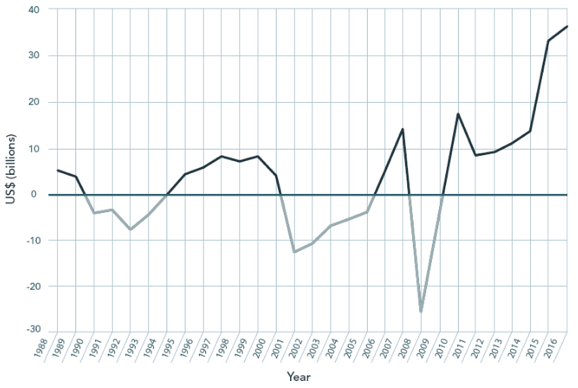
Aviation has always been a cyclical industry directly and rapidly impacted by downturns in the economy. The industry reported losses in the early 1990s due to the recession and again in 2001 after the 9/11 attacks; in 2003 following the SARS epidemic, and in 2008 linked to the financial crisis. Each of these downturns was followed by a period of economic recovery.
Looking specifically at SARS, airlines lost $6 billion in revenues with the outbreak's economic impact having a V-shape where the rapid decline was matched by a speedy economic recovery.
Despite the airline industry's cyclical nature it has maintained profitability for the past 10 years, with a profit of $25.9 billion in 2019 despite recent tragedies and challenges, according to IATA. For example, the sector faced the 737 Max accidents in 2018 and 2019, the Ukraine Airlines Flight 752 shot down in Iran, and the emergence of “flygskam” flight shaming air travel due to its emissions. Each of these events impacts passenger confidence in aviation, and many industry experts were bracing for an economic decline as a result.
The industry maintaining profitability over the last decade is a testament to its strength and resilience.
The COVID-19 pandemic is testing the aviation sector in new ways. The entire industry is being stretched to a breaking point, without interventions, it can not survive the crisis.
Assuming travel restrictions are lifted after three months, 2020's passenger demand will be 38 per cent less than 2019, resulting in an impact of USD$ 252 billion according to IATA. Airports are projected to lose $46 billion in 2020, said Airport Council International (ACI). Although previous pandemics were followed by a sharp recovery, they did not cause recessions as COVID-19 might.
This has led to three critical questions about the future of international aviation.
- When will the impacts of COVID-19 subside – and what will society look like when it does?
- How long will it take for people to have the funds and confidence to begin flying again?
- What specifically can be done to ensure the industry survives the crisis? How can we innovate during the downturn to craft a stronger future?
The most pressing need for aviation is essential financial support through the pandemic, and in the coming months as society faces future waves of the virus. Beyond support to operators, it is critical to recognize that this situation also creates an opportunity to reflect upon and innovate practices within the industry.
We will overcome this challenge, and hopefully build a better future. Key priorities during this time should explore how to mobilize Canada's innovation and research infrastructure towards aviation challenges. We have leading researchers in sustainability, cognitive science and engineering, material science, machine learning, automation, cybersecurity, and artificial intelligence among other areas. We are in a position to apply Canadian expertise towards aviation innovations, as important elements of our economic recovery strategy.
What is certain is that COVID-19 will change the world – what is unknown is how we can learn from this to create a stronger and more resilient future together.
https://www.skiesmag.com/news/covid-19-and-aviation-survival-recovery-and-innovation